FREE WORLDWIDE SHIPPING

Buying Guides, Care & Maintenance, Chef & Cooking Content, Comparisons, Cutting Boards, Teak Wood Education
Wooden vs. Stainless Steel Utensils: What Chefs Prefer

“Professional kitchens test every tool under heat, speed, and pressure. Chefs compare wooden and stainless steel utensils by how they treat cookware, handle heat, and feel in the hand. This guide explains why many cooks reach for teak, where steel still wins, and how to build a smarter set.”
Chefs rarely agree on gear, but they agree on this: the right utensil protects the pan. Wooden utensils glide across nonstick, enameled, and cast iron surfaces without leaving marks. Stainless steel utensils scrape, scratch, and conduct heat straight to your hand.
Steel earns its place for searing, flipping, and plating. Wood earns its place for stirring, sautéing, and everyday cooking. Most chefs keep both, but they reach for wood first. This guide compares them by heat transfer, cookware safety, hygiene, and long-term value.
Cool-Touch Handles
STAYS COOL IN HAND
Cookware-Safe Surfaces
PROTECTS NONSTICK AND ENAMEL
Dense Teak Grain
RESISTS MOISTURE NATURALLY
The sections below cover history, specifications, benefits, care, and a five-step process for choosing utensils.
🌿
Our Top Pick
A Board Worthy of Wooden Tools
Chefs who choose wooden utensils usually choose a wooden board too. This handmade teak board gives your knives the same gentle surface your pans get from wood.
✦ Editor's Pick ✦
★★★★★
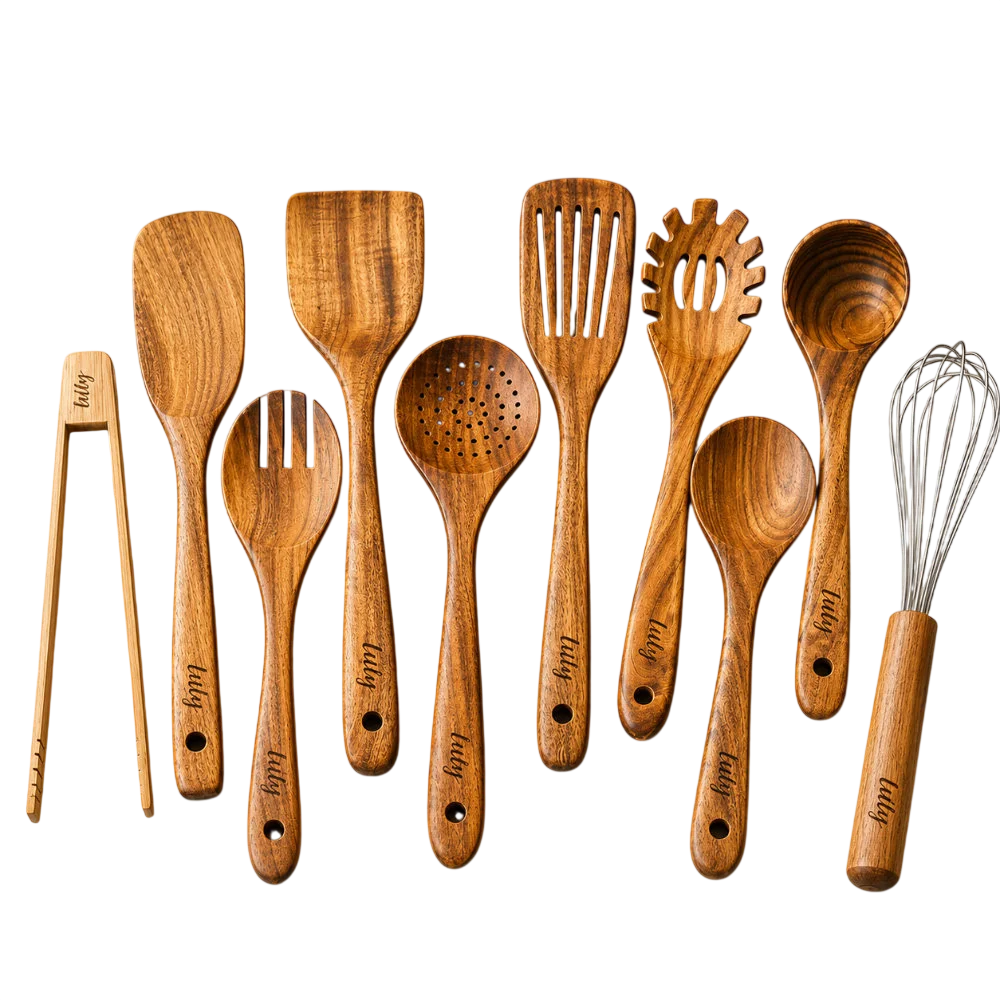
Lilly Teak — 10 Piece Handmade Utensil Set
Handcrafted · Sustainable · Zero Plastic
The Lilly Teak 10-piece set is everything we look for in a kitchen essential: beautifully crafted from solid teak, shaped by hand for an ergonomic feel, and designed to serve your family for decades. Each piece is unique, with its own natural grain pattern — no two sets are ever identical.
- 10 essential kitchen tools
- Hand-shaped & finished
- Non-scratch on all cookware
- 100% solid teak wood
- Food-safe oil treatment
- Sustainably sourced wood
🌿
FROM CARVED SPOONS TO STEEL
Utensil History
People have carved wooden spoons for thousands of years. Early cooks shaped them from local hardwoods because wood was available, safe on clay pots, and easy to repair. Cooks across Southeast Asia chose teak for its density and natural oils. Shipbuilders chose it for the same reasons.
Stainless steel arrived much later. Harry Brearley, a Sheffield metallurgist, developed a rust-resistant steel alloy in 1913. Restaurants adopted steel tools for durability and easy sanitizing. Home cooks followed. Nonstick pans then exposed steel’s biggest flaw: scratched coatings. Chefs returned to wood for everyday cooking and kept steel for specialized tasks.
Teak (Tectona grandis) grows in tropical Asia. Its natural oils made it a favorite for ships, outdoor furniture, and kitchenware. Today, artisans hand-shape teak into utensils and boards, so each piece shows a unique grain.
🌿
HEAT, HARDNESS, AND WEIGHT
Material Specifications
Six measurable differences explain why chefs reach for wood first.
- Thermal conductivity: Stainless steel conducts heat roughly 100 times faster than teak. Steel handles burn hands during long cooks. Teak handles stay comfortable.
- Hardness: Teak rates about 1,000 lbf on the Janka scale. Steel is harder than any pan coating, so it scratches nonstick and enamel surfaces.
- Natural oils: Teak contains oils that repel water. These oils help the wood resist warping, cracking, and rot.
- Weight and balance: Wood feels light and balanced in the hand. Steel feels heavier and more rigid, which suits precise flipping.
- Heat limit: Steel tolerates any stovetop temperature. Wood scorches if you leave it in a hot, dry pan.
- Dishwasher safety: Steel survives the dishwasher. Wood needs hand washing to keep its finish.
These specifications favor wood for daily cooking and steel for high-heat, precision work.
🌿
KITCHEN PERFORMANCE
Chef Performance
Specifications matter less than performance on a busy line. Chefs judge utensils by how they behave during real tasks.
Stirring and Sautéing
Wood grips food and moves it gently. A wooden spoon scrapes browned bits from the pan bottom without gouging the surface. It also stays quiet on hot, crowded burners.
Flipping and Searing
Steel offers a thin, sharp edge that slides under delicate fish and crisp crusts. Chefs value that precision. Wood works well for burgers and pancakes but feels thick under fragile foods.
Serving and Plating
Wooden serving spoons look warm on the table and never clang against dishes. Steel tongs and spoons look sleek and clean quickly between courses.
Long Cooks and Sauces
Slow braises and simmered sauces favor wood. A steel spoon left in the pot gets hot within minutes. A wooden spoon rests safely against the rim all afternoon.
Cleanup Between Tasks
Steel cleans fast and tolerates harsh detergents. Wood needs a quick rinse and prompt drying. Both take under a minute per tool.
🌿
SIX REASONS TEAK WINS
Teak Benefits
Chefs choose utensils for daily comfort, not novelty. Teak delivers six practical advantages that steel cannot match. Each one comes from the wood itself.
Density, oil content, and natural grain create these benefits. No coating or treatment replaces them. You notice them within the first week of use.
🍳
Pan-safe
Glides over nonstick and enamel without scratches.
🧊
Cool handles
Stays comfortable during long simmers.
🔇
Quiet stirring
Taps softly instead of clanking on metal.
💧
Water resistant
Natural oils slow moisture absorption.
🔪
Knife-friendly
A dense grain surface protects blade edges.
🌱
Sustainable
Responsibly sourced wood replaces plastic and metal.
“I swapped my steel spatula for teak and stopped scratching my pans. The board now anchors my whole counter.”
— Carla V.
🌿
Our Top Pick
A Teak Board for Everyday Cooking
Pair wooden spoons with a surface that respects them. This board resists moisture, protects knife edges, and cleans with soap and water.
✦ Editor's Pick ✦
★★★★★
Lilly Teak — 10 Piece Handmade Utensil Set
Handcrafted · Sustainable · Zero Plastic
The Lilly Teak 10-piece set is everything we look for in a kitchen essential: beautifully crafted from solid teak, shaped by hand for an ergonomic feel, and designed to serve your family for decades. Each piece is unique, with its own natural grain pattern — no two sets are ever identical.
- 10 essential kitchen tools
- Hand-shaped & finished
- Non-scratch on all cookware
- 100% solid teak wood
- Food-safe oil treatment
- Sustainably sourced wood
🌿
WOOD VERSUS STEEL
Side-by-Side Comparison
This table compares teak and steel on the three factors chefs mention most.
|
Feature |
Teak Wood |
Stainless Steel |
Chef Pick |
|---|---|---|---|
|
Cookware safety |
Gentle on every coating |
Scratches nonstick |
Wood |
|
Handle comfort |
Stays cool |
Heats quickly |
Wood |
|
Searing and flipping |
Thicker edge |
Thin, precise edge |
Steel |
Pros and Cons at a Glance
- Wood pros: Cookware-safe, cool handles, quiet, renewable.
- Wood cons: Needs hand washing, occasional oiling, and scorches on dry heat.
- Steel pros: Dishwasher-safe, precise edge, handles any temperature.
- Steel cons: Scratches coatings, conducts heat, clanks loudly.
Chefs split work by task. Wood handles stirring, sautéing, and serving. Steel handles flipping, scraping, and plating. A two-material kit costs little and covers every technique. Start with wood for daily tasks and add one steel spatula for searing.
🌿
FIVE-STEP CARE ROUTINE
Care and Maintenance
Teak lasts decades with simple habits.
- Wash by hand with warm water and mild soap.
- Dry immediately with a clean towel.
- Air dry upright so both sides breathe.
- Oil monthly with a food-safe plant-based or mineral oil. Dry wood looks pale and feels rough.
- Never soak the wood or run it through a dishwasher.
Sand light roughness with fine sandpaper, then re-oil. Remove stains with lemon juice and coarse salt. Replace any utensil with deep cracks. Steel needs only a dishwasher cycle. Wood needs a few minutes of care.
🌿
CLEANLINESS FACTS
Hygiene and Safety
Many cooks worry that wood harbors bacteria. Some studies on wooden boards found that bacteria absorb into the grain and die off. Deep cracks and neglect create the real risk.
Teak helps because its dense grain and natural oils limit moisture absorption. Less moisture means fewer places for bacteria to settle. A plant-based finish also keeps the surface free from synthetic sealants.
Follow four safety rules:
- Use separate utensils for raw meat and ready-to-eat food.
- Wash wood after every use with hot, soapy water.
- Retire any utensil with deep cracks or splinters.
- Wipe boards with diluted white vinegar after raw poultry.
Stainless steel resists absorption entirely, which simplifies sanitizing. Wood rewards consistent habits.
🌿
FIVE BUYING STEPS
How to Choose
Follow these steps to match utensils to your cooking.
- Match the material to your cookware. Choose wood for nonstick, enamel, and cast iron. Reserve steel for stainless pans and grills.
- List your daily tasks. Pick wood for stirring and serving. Pick steel for flipping and scraping.
- Check the wood species. Choose dense hardwoods such as teak. Dense grain resists moisture and wear.
- Inspect the finish. Prefer plant-based oil over synthetic sealants or varnish. Ask the maker what the finish contains.
- Build a matching set. Include a spoon, a spatula, and a board. Matching tools wear evenly and look cohesive.
Buy one quality set instead of many cheap tools. Quality wood lasts decades, and replacement costs add up.
🌿
Our Top Pick
Complete Your Teak Kitchen
Finish your setup with a board built for daily prep. Hand-shaped teak and a plant-based finish give you a food-safe surface for every meal.
✦ Editor's Pick ✦
★★★★★
Lilly Teak — 10 Piece Handmade Utensil Set
Handcrafted · Sustainable · Zero Plastic
The Lilly Teak 10-piece set is everything we look for in a kitchen essential: beautifully crafted from solid teak, shaped by hand for an ergonomic feel, and designed to serve your family for decades. Each piece is unique, with its own natural grain pattern — no two sets are ever identical.
- 10 essential kitchen tools
- Hand-shaped & finished
- Non-scratch on all cookware
- 100% solid teak wood
- Food-safe oil treatment
- Sustainably sourced wood
🌿
FAQ
Do professional chefs use wooden utensils?
Yes. Most chefs use wooden spoons and spatulas for stirring and sautéing. They keep steel tools for flipping, scraping, and plating.
Do stainless steel utensils scratch nonstick pans?
Yes. Steel is harder than nonstick coatings and leaves scratches. Scratched coatings flake and wear out faster.
Are wooden utensils sanitary?
Yes, with proper care. Wash by hand, dry quickly, and oil monthly. Replace utensils that crack or develop deep grooves.
Can wooden utensils go in the dishwasher?
No. Heat and long soaking cause warping and cracking. Hand wash with warm water and mild soap.
Why is teak better than other woods?
Teak contains natural oils that resist moisture and warping. It stays smooth and holds up through years of daily use.
How often should I oil teak?
Oil teak monthly, or whenever it looks dry or pale. Use a food-safe plant-based or mineral oil.
🌿
Final Verdict
Wooden utensils win for daily cooking. They protect cookware, stay cool, and last for decades with simple care. Stainless steel wins for precision tasks and dishwasher convenience. Chefs use both, but wood carries most of the workload.
Start with teak spoons and spatulas, then add a steel flipper if you sear often. Pair them with a handmade teak cutting board to protect your knives and your counters. Choose quality materials once, and your kitchen tools will serve you for years.
Wood for the pan, steel for the sear.🌿