
Wooden vs Silicone Utensils

"A good wooden spoon outlasts nearly everything else in a kitchen drawer. Teak wood utensils bring natural strength, a warm handmade feel, and decades of daily use. Silicone tools offer a lighter, disposable alternative. This guide shows why teak wood remains the stronger choice for cooks who want tools built to last."
Every cook eventually asks the same question: wood or silicone? The answer matters more than it seems, because the utensil drawer sees more daily use than almost any other part of the kitchen. Teak wood utensils lead this comparison for one simple reason: they last. A well-made teak spoon can outlive several sets of silicone tools, all while protecting cookware and staying entirely natural, with no synthetic material at all.
Silicone has its place for specific tasks, and this guide covers where it fits. But the core focus here is teak wood — how it performs, why it holds up, and how to care for it so it lasts for decades in your kitchen.
Built to Last Decades
TEAK RESISTS DAILY WEAR
Naturally Antibacterial
TANNINS FIGHT BACTERIA GROWTH
100% Natural Material
NO SYNTHETIC INGREDIENTS
Teak wood utensils bring a combination of strength, natural food safety, and a handmade feel that few other kitchen materials can match. The sections below cover the history, specifications, benefits, and care of teak wood utensils, along with a straightforward comparison to silicone for anyone weighing both options.
Our Top Pick
Everyday Strength, Handmade Quality
Teak utensils bring natural durability and warmth to daily cooking, and a full set covers nearly every task at the stove.
★★★★★
Lilly Teak — 10 Piece Handmade Utensil Set
Handcrafted · Sustainable · Zero Plastic
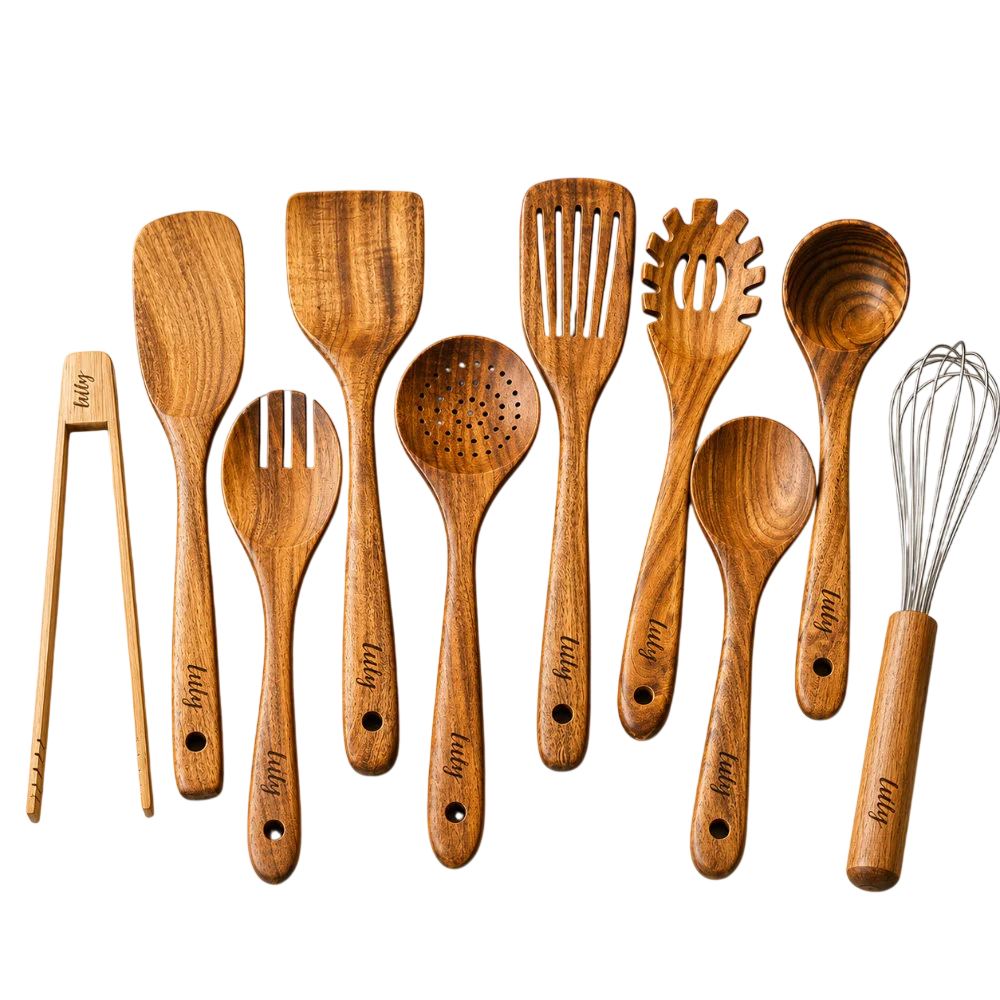
The Lilly Teak 10-piece set is everything we look for in a kitchen essential: beautifully crafted from solid teak, shaped by hand for an ergonomic feel, and designed to serve your family for decades. Each piece is unique, with its own natural grain pattern — no two sets are ever identical.
- 10 essential kitchen tools
- Hand-shaped & finished
- Non-scratch on all cookware
- 100% solid teak wood
- Food-safe oil treatment
- Sustainably sourced wood
A TRADITION THAT STARTED WITH WOOD
The History of Teak Wood Utensils
Wooden utensils go back thousands of years. Early cooks carved spoons from branches and bone, and Ancient Egyptians used wooden spoons for both cooking and serving. Wood stayed the standard kitchen material for centuries because it required no factory and no chemical process — just a craftsman's hand and a solid piece of timber.
Teak earned a special place among cooking woods because of where it grows. Coastal regions of Southeast Asia relied on teak for kitchen tools because the wood resisted rot in humid, tropical air. That same natural oil content is why teak utensils still outperform softer woods today. Silicone entered the picture much later. Chemists developed the synthetic polymer in the 1930s, but it did not reach home kitchens in force until the 1990s, when brands marketed it as a soft-edged partner for non-stick cookware.
WHY TEAK OUTPERFORMS
Teak Wood vs Silicone at a Glance
Teak's density and natural oil content set it apart from both softer woods and synthetic materials. The table below shows how teak measures up.
|
Material |
Heat Resistance |
Hardness |
Water Resistance |
Typical Lifespan |
|---|---|---|---|---|
|
Teak |
High |
Very high |
High |
Decades |
|
Beech |
Moderate |
High |
Moderate |
Years |
|
Bamboo |
Moderate |
Moderate |
Low |
1–2 years |
|
Food-Grade Silicone |
Very high |
Low (flexible) |
High |
3–5 years |
Teak leads the field on hardness, water resistance, and lifespan. Silicone only pulls ahead on raw heat tolerance, which matters far less in daily stirring, mixing, and serving than it does in rare high-heat searing.
"I switched to a teak utensil set last year and I'm still surprised at how solid it feels. Nothing scratches my pans, and it's held up better than any wooden spoon I've owned before."
— Sarah K.
WHAT MAKES TEAK DIFFERENT
Technical Specifications of Teak Wood
Teak is a dense hardwood built from tight cellulose fibers, natural lignin, and a high concentration of natural oils. Those oils are what give teak its edge: they seal the wood's pores from the inside, blocking moisture and bacteria without any added treatment. Teak measures near 1,000 on the Janka hardness scale, well above softer woods like pine, which score closer to 400. That hardness is why a teak utensil resists dents, cracks, and warping far longer than a basic wooden spoon.
Teak also carries a low thermal conductivity rating, so it stays cool to the touch even resting against a hot pan. Silicone, by comparison, is a cured synthetic polymer with a heat rating between 428°F and 500°F. It resists melting at high temperatures, but it lacks the natural density and grain structure that make teak feel solid and substantial in the
WHY TEAK STANDS OUT
Benefits of Teak Wood Utensils
Teak brings a set of natural advantages that make it a favorite for daily cooking, from raw durability to a fully natural composition with no synthetic ingredients.
Natural Durability
Teak holds up for decades.
Naturally Antibacterial
Tannins resist bacteria growth.
Zero Microplastics
No plastic sheds into food.
High Heat Tolerance
Silicone resists melting near flame.
Rich, Unique Grain
No two pieces ever look alike.
Sustainably Sourced
Renewable material, biodegradable at end of life.
These six strengths explain why teak keeps earning a spot in kitchens that value tools built to last, not replaced every season.
Our Top Pick
Built to Handle Daily Cooking
A full set of teak tools covers the stirring, scraping, and serving jobs that come up every single day.
★★★★★
Lilly Teak — 10 Piece Handmade Utensil Set
Handcrafted · Sustainable · Zero Plastic
The Lilly Teak 10-piece set is everything we look for in a kitchen essential: beautifully crafted from solid teak, shaped by hand for an ergonomic feel, and designed to serve your family for decades. Each piece is unique, with its own natural grain pattern — no two sets are ever identical.
- 10 essential kitchen tools
- Hand-shaped & finished
- Non-scratch on all cookware
- 100% solid teak wood
- Food-safe oil treatment
- Sustainably sourced wood
KEEPING TOOLS IN SHAPE
How to Maintain Wood and Silicone Utensils
Teak asks for very little upkeep given how long it lasts. A simple monthly routine keeps every piece performing like new.
- Hand wash with warm water and mild soap after each use
- Dry immediately with a towel — never air dry standing in water
- Apply food-grade mineral oil or plant-based wood oil once a month
- Store in a dry area away from direct sunlight
- Avoid the dishwasher, which strips natural oils and can cause cracking
Silicone tools ask for less monthly attention since most are dishwasher safe, but that convenience comes at a cost: silicone tools show wear and often need replacing within a few years, while a well-oiled teak piece can stay in service for decades.
Wooden vs Silicone Utensils
|
Feature |
Wooden Utensils |
Silicone Utensils |
Winner |
|---|---|---|---|
|
Cookware protection |
Gentle on non-stick and cast iron surfaces |
Gentle on non-stick, firm on cast iron seasoning |
Teak |
|
Lifespan with care |
Decades with monthly oiling |
Several years before wear appears |
Teak |
|
Environmental impact |
Biodegradable, renewable, natural material |
Long-lasting but not biodegradable |
Teak |
|
Maintenance effort |
Monthly oiling, hand wash only |
Dishwasher safe, minimal upkeep |
Silicone |
|
Heat resistance |
Handles moderate to high heat without melting |
Rated up to 500°F, resists melting |
Silicone |
Teak wins where it matters most for a long-term kitchen investment: durability, cookware protection, and environmental impact. Silicone only pulls ahead on convenience and raw heat tolerance, two factors that matter far less than a tool's ability to last.
CHOOSING TEAK FOR YOUR KITCHEN
How to Choose Teak Wood Utensils
- Start with your most-used tools. Replace your everyday spoon, spatula, and serving pieces with teak first — they see the most daily wear.
- Check your cookware. Teak protects non-stick and cast iron surfaces better than any metal or hard plastic tool.
- Commit to a simple care routine. A monthly oiling and hand wash is all teak needs to last for decades.
- Look for solid, hand-shaped construction. Handmade teak pieces hold up better than mass-produced, laminated wood tools.
- Reserve silicone for specific jobs only. A single silicone spatula for high-heat searing or scraping bowls can round out a teak-first kitchen.
- Choose a full set over single pieces. A matched teak set gives every task in the kitchen a consistent, durable tool.
Our Top Pick
Complete Your Kitchen Tool Collection
One handmade teak set gives you a full lineup of stirring, serving, and scraping tools in a single purchase.
★★★★★
Lilly Teak — 10 Piece Handmade Utensil Set
Handcrafted · Sustainable · Zero Plastic
The Lilly Teak 10-piece set is everything we look for in a kitchen essential: beautifully crafted from solid teak, shaped by hand for an ergonomic feel, and designed to serve your family for decades. Each piece is unique, with its own natural grain pattern — no two sets are ever identical.
- 10 essential kitchen tools
- Hand-shaped & finished
- Non-scratch on all cookware
- 100% solid teak wood
- Food-safe oil treatment
- Sustainably sourced wood
FAQ
Teak's natural oils seal the wood from the inside, blocking moisture and bacteria without any added treatment. That density is also why teak resists cracking and warping far longer than softer woods or synthetic materials.
No. Teak is softer than metal cookware coatings, so it protects non-stick surfaces during daily cooking rather than wearing them down.
Oil teak tools once a month under normal use. Oil more often if the wood starts to look dry or dull.
No. Dishwasher heat and detergent strip teak's natural oils and can cause cracking. Hand wash and dry teak tools immediately after each use.
Yes. Teak contains natural antibacterial compounds called tannins, which resist bacteria growth on the surface of the wood.
Silicone works well for high-heat searing tasks and for cooks who want every tool to be dishwasher safe. Most kitchens do well with a teak set for daily use and one or two silicone pieces for specific jobs.
Final Verdict
Teak wood utensils lead this comparison on nearly every measure that matters for a long-term kitchen investment. They resist bacteria naturally, protect cookware, and hold up for decades with a simple monthly care routine. Silicone offers convenience and heat tolerance, but it wears out faster and never matches the density or natural feel of solid teak.
For most kitchens, a full teak set covers daily cooking needs better than any synthetic alternative. Add a single silicone tool only if a specific high-heat task calls for it. Everything else belongs in teak.
Teak wood earns its place in the kitchen one meal at a time, built to outlast trends and outperform anything synthetic. 🌿