
Best Wooden Utensil Set

"A cook reaches for a spoon. The spoon does not scratch the pan. It does not hold odor. It does not crack after one season. This is the quiet promise of a good wooden utensil set: fewer replacements, better food, and a kitchen tool that ages well instead of wearing out."
A wooden utensil set is a group of cooking tools carved from solid wood. The set usually includes a spoon, a spatula, a slotted spoon, and a fork. Each tool serves a specific cooking task. Together, they cover most stovetop needs.
Wood remains a top material choice for kitchen tools. It resists heat. It protects nonstick and cast-iron surfaces. It does not leach chemicals into food. These qualities make wooden utensils a practical pick for home cooks and professional chefs alike.
Durability
YEARS OF DAILY USE
Sustainability
GROWN FROM RENEWABLE FORESTS
Knife-Safe Design
GENTLE ON KNIFE EDGES
Paragraph 3: Lorem ipsum dolor sit amet, consectetur adipiscing elit. Ut elit tellus, luctus nec ullamcorper mattis, pulvinar dapibus leo.
Our Top Pick
The Set Built to Replace Your Whole Drawer
Skip the piecemeal upgrades. This 10-piece teak set covers every stovetop task in one purchase.
★★★★★
Lilly Teak — 10 Piece Handmade Utensil Set
Handcrafted · Sustainable · Zero Plastic
The Lilly Teak 10-piece set is everything we look for in a kitchen essential: beautifully crafted from solid teak, shaped by hand for an ergonomic feel, and designed to serve your family for decades. Each piece is unique, with its own natural grain pattern — no two sets are ever identical.
- 10 essential kitchen tools
- Hand-shaped & finished
- Non-scratch on all cookware
- 100% solid teak wood
- Food-safe oil treatment
- Sustainably sourced wood
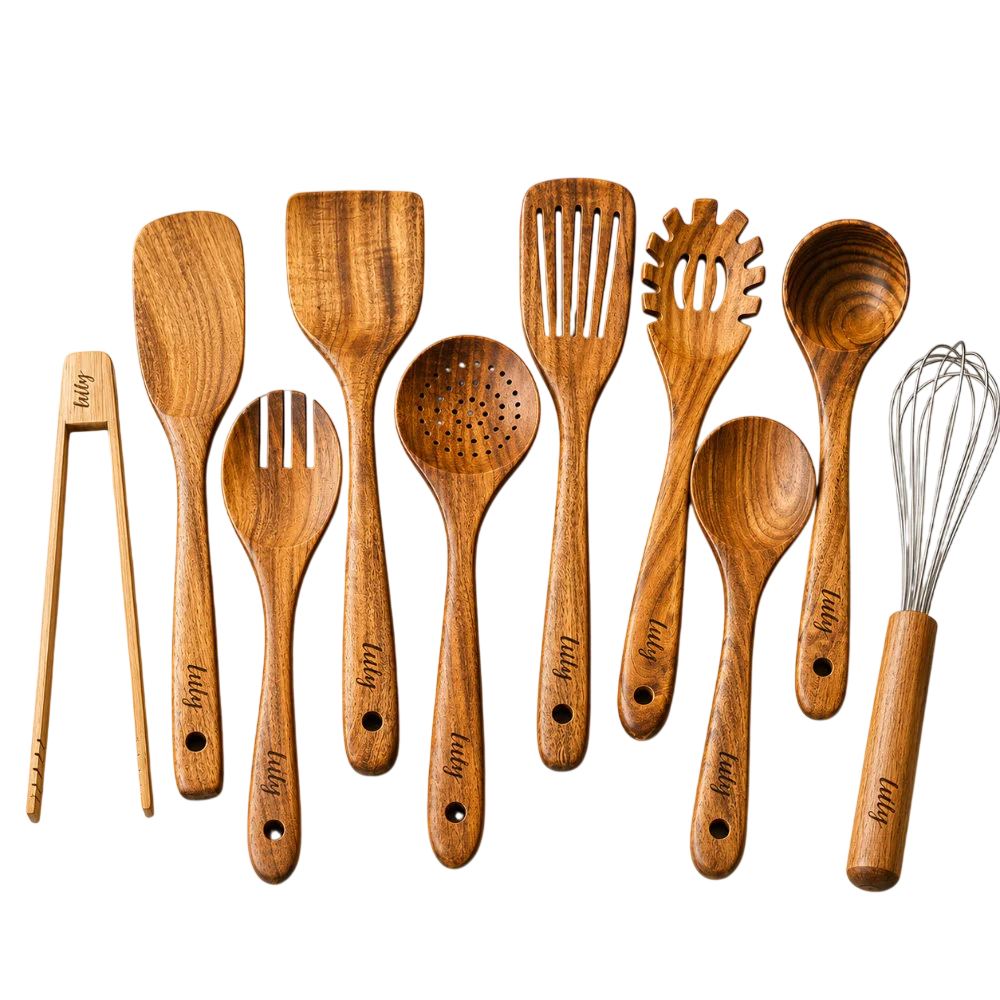
THE BACKSTORY
A Short History of Wooden Utensils
Wood tools predate metal cookware by thousands of years. Early cooks carved spoons and paddles from local timber. They shaped these tools by hand, using stone blades and fire.
Ancient kitchens in Egypt, Greece, and China used wooden spoons for stirring grain and broth. Wood was abundant. It was easy to shape. It did not conduct heat like metal did.
Teak entered the kitchen story through Southeast Asian shipbuilding. Shipwrights valued teak for its natural oils and water resistance. Those same properties later made teak a strong choice for cutting boards, bowls, and utensils. The wood resists rot, warping, and bacterial growth better than most hardwoods.
Modern manufacturing introduced plastic and silicone tools in the mid-20th century. These materials offered low cost and mass production. But they also introduced new problems: melting, staining, and microplastic shedding. Wood never left professional kitchens. Chefs kept choosing it for its balance of strength and food safety.
Today, wooden utensil sets combine old-world material with modern shaping techniques. The result is a tool that performs like its ancient ancestors, built with tighter tolerances and smoother finishes.
HOW THEY'RE BUILT
Technical Specifications of a Wooden Utensil Set
A quality wooden utensil set follows specific construction standards. These standards affect performance, safety, and lifespan.
Wood Type Teak is a top-tier choice. It contains natural oils called tectoquinones. These oils repel water and resist fungal growth. Other common woods include beech, olive, and bamboo. Each has different density and oil content.
Grain Direction Manufacturers cut utensils along the wood grain, not against it. Grain-aligned cuts resist splitting under pressure. A spatula edge cut against the grain will chip faster.
Finish A food-safe finish seals the wood without blocking its natural texture. Plant-based oils, like flaxseed or mineral oil blends, penetrate the wood fibers. Synthetic lacquers sit on top of the wood and can crack or peel.
Thickness and Weight Utensil thickness affects strength. A spoon under 4mm thick tends to bend or snap under heavy stirring. Most teak utensils run between 5mm and 8mm at the thickest point.
Set Composition A standard set includes:
- Solid spoon for stirring sauces and soups
- Slotted spoon for draining and lifting food from liquid
- Spatula (flat-edge) for flipping and scraping pans
- Fork or tongs for turning meat and vegetables
- Optional rice paddle or spork for grains
WHY COOKS CHOOSE WOOD
Benefits of a Wooden Utensil Set
Home cooks and chefs choose wood for measurable reasons, not aesthetics alone.
Heat Resistant
Wood does not conduct heat like metal. A wooden spoon resting in a hot pot stays cool to the touch.
Pan Safe
Wood will not scratch nonstick coatings, cast iron seasoning, or enamel surfaces.
Chemical Free
Solid wood contains no plastic resins, dyes, or PFAS coatings.
Quiet in Use
Wood makes less noise against metal or ceramic cookware than plastic or metal tools.
Naturally Antibacterial
Teak's natural oils slow bacterial growth on the utensil surface between washes.
Long Lifespan
A well-made wooden utensil can last a decade or longer with basic care.
These benefits compound over time. A homeowner who buys one solid wooden set often replaces plastic tools less frequently, which reduces long-term kitchen spending.
"I switched my whole drawer to wood two years ago. My pans look brand new, and I haven't thrown out a single spoon."
— Marissa T.
Our Top Pick
Every Tool Covered in One Set
Solid spoon, slotted spoon, spatula, fork, and more — this set checks every box the sections above cover, without buying pieces separately.
★★★★★
Lilly Teak — 10 Piece Handmade Utensil Set
Handcrafted · Sustainable · Zero Plastic
The Lilly Teak 10-piece set is everything we look for in a kitchen essential: beautifully crafted from solid teak, shaped by hand for an ergonomic feel, and designed to serve your family for decades. Each piece is unique, with its own natural grain pattern — no two sets are ever identical.
- 10 essential kitchen tools
- Hand-shaped & finished
- Non-scratch on all cookware
- 100% solid teak wood
- Food-safe oil treatment
- Sustainably sourced wood
CARING FOR YOUR SET
Maintenance and Care
Wooden utensils need simple, consistent care. Skipping care steps shortens their lifespan.
Washing
Hand wash utensils with warm water and mild soap. Avoid dishwashers. Dishwasher heat and prolonged water exposure cause cracking and warping.
Drying
Dry utensils immediately after washing. Standing water swells wood fibers and weakens the surface over time.
Oiling
Apply food-safe mineral oil or a plant-based wood conditioner once a month. Rub a thin layer across the surface, then wipe off excess after ten minutes.
Storage
Store utensils upright in a holder or flat in a dry drawer. Avoid storing them wet or stacked against damp cookware.
Avoiding Damage
Do not leave wooden utensils resting in hot liquid for extended periods. Do not place them near direct flame or under a broiler.
A basic monthly oiling routine keeps the wood sealed and prevents cracking. This single habit extends utensil life by years.
MATERIAL COMPARISON
Wood vs. Plastic vs. Silicone
|
Material |
Heat Resistance |
Pan Safety |
Lifespan |
|---|---|---|---|
|
Teak Wood |
High — stays cool |
Safe on nonstick and cast iron |
10+ years with care |
|
Plastic |
Low — can melt or warp |
Can scratch coatings over time |
1–3 years |
|
Silicone |
High — heat resistant |
Safe on most surfaces |
3–5 years |
Wood outperforms plastic in lifespan and pan safety. Silicone matches wood on heat resistance but falls short on natural material appeal and long-term durability. Teak remains the strongest overall choice for cooks who want fewer replacements and a tool that improves with age.
Our Top Pick
Ready to Make the Switch?
If you've read this far, you already know why wood wins. Here's the set that makes the switch easy.
★★★★★
Lilly Teak — 10 Piece Handmade Utensil Set
Handcrafted · Sustainable · Zero Plastic
The Lilly Teak 10-piece set is everything we look for in a kitchen essential: beautifully crafted from solid teak, shaped by hand for an ergonomic feel, and designed to serve your family for decades. Each piece is unique, with its own natural grain pattern — no two sets are ever identical.
- 10 essential kitchen tools
- Hand-shaped & finished
- Non-scratch on all cookware
- 100% solid teak wood
- Food-safe oil treatment
- Sustainably sourced wood
How to Choose the Right Set
Follow these steps to pick a wooden utensil set that fits your kitchen.
- Check the wood type. Choose teak or another dense, oil-rich hardwood for the longest lifespan.
- Inspect the grain cut. Confirm the utensils are cut along the grain, not against it.
- Confirm the finish. Look for a plant-based oil finish, not a synthetic lacquer.
- Match the set to your cooking style. A cook who fries often needs a flat spatula. A cook who simmers sauces needs a deep solid spoon.
- Measure handle length. Longer handles suit deep pots. Shorter handles suit pans and skillets.
- Review the seller's sourcing claims. Choose brands that state their wood source and finishing process clearly.
FAQ
No. Dishwasher heat and water exposure cause wood to crack and warp over time.
Oil them once a month with a food-safe mineral or plant-based oil.
Yes. Wood is soft enough to avoid scratching nonstick coatings.
Teak contains natural oils that resist water and bacteria, which increases its durability and price.
Properly oiled and dried wood resists odor absorption far better than untreated or low-quality wood.
With regular oiling and hand washing, a solid teak set can last ten years or more.
Final Verdict
A wooden utensil set is a practical, long-term kitchen investment. It protects your cookware, resists heat, and avoids the chemical concerns tied to plastic tools. Teak stands out among wood choices for its natural oil content and resistance to bacteria and moisture.
Choose a set built along the wood grain, finished with plant-based oil, and matched to your cooking habits. Pair it with a solid cutting board for a complete, low-maintenance kitchen setup that holds up for years.
One good set. Fewer replacements. A kitchen built to last. 🌿