
How Long Do Wooden Utensils Last?

"A good wooden spoon outlives most kitchen tools. It resists heat, protects your pans, and ages into something better than new. This guide explains how long wooden utensils last, what shortens their life, and how to pick a set that lasts for decades."
Wooden utensils last longer than most cooks expect. A quality wooden spoon or spatula lasts 10 to 20 years with basic care. Cheap, thin utensils crack within a year. The wood type, the finish, and your maintenance routine decide the outcome.
This guide covers the full lifespan story. You will learn the history behind wooden kitchen tools, the technical factors that control durability, and the exact steps to extend the life of your set. Teak wood stands out in every category, and we explain why below.
Long-Lasting Wood
LASTS TEN PLUS YEARS
Chemical-Free Finish
RESISTS BACTERIA NATURALLY
Simple Upkeep
NEEDS MONTHLY OILING ONLY
Wood density decides most of the outcome. Dense woods like teak resist cracking, warping, and bacterial growth better than soft woods like pine or bamboo. A plant-based oil finish adds another layer of protection. Together, wood choice and finish quality explain why some utensils last two years and others last twenty.
Our Top Pick
The Teak Set Built to Outlast Your Kitchen
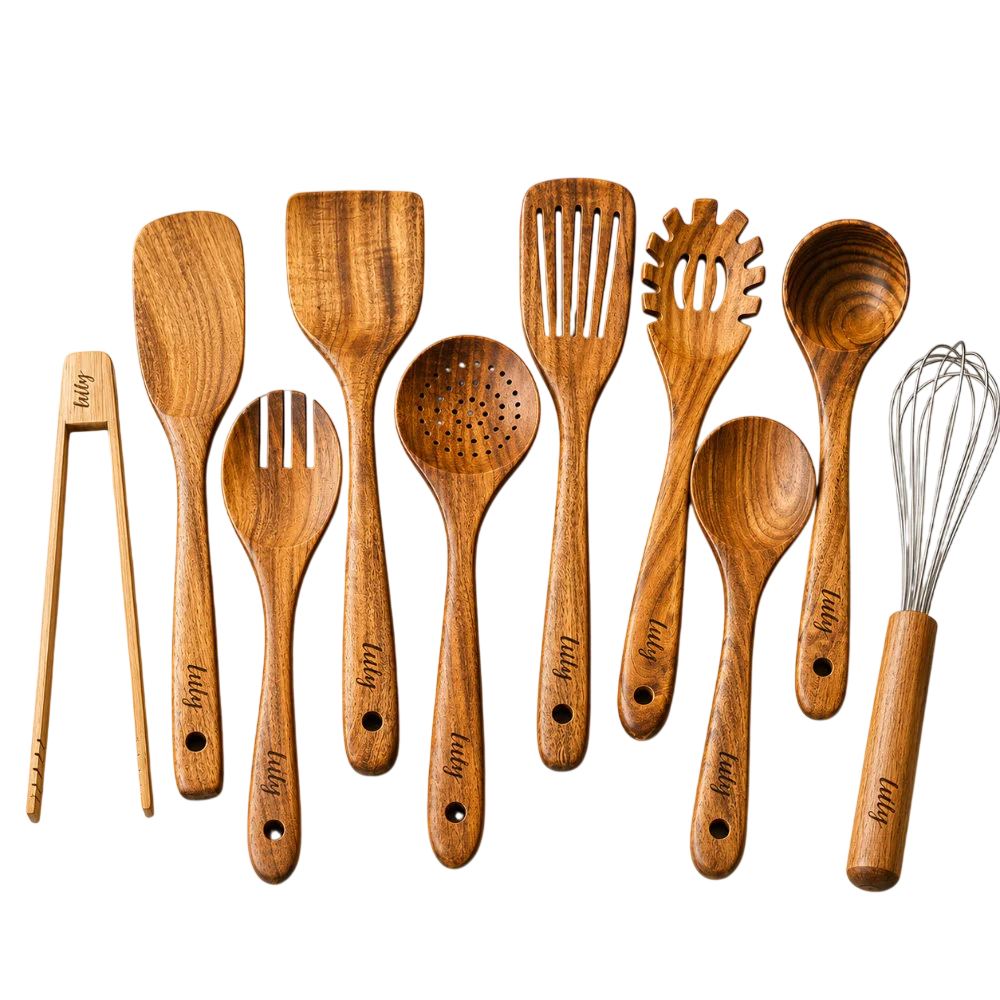
Lilly Teak carves each utensil from solid teak wood and finishes it by hand. The set resists heat, repels moisture, and develops a richer color with age instead of breaking down.
★★★★★
Lilly Teak — 10 Piece Handmade Utensil Set
Handcrafted · Sustainable · Zero Plastic
The Lilly Teak 10-piece set is everything we look for in a kitchen essential: beautifully crafted from solid teak, shaped by hand for an ergonomic feel, and designed to serve your family for decades. Each piece is unique, with its own natural grain pattern — no two sets are ever identical.
- 10 essential kitchen tools
- Hand-shaped & finished
- Non-scratch on all cookware
- 100% solid teak wood
- Food-safe oil treatment
- Sustainably sourced wood
CARVED FOR CENTURIES
A Short History of Wooden Kitchen Tools
Wooden spoons predate metal cookware by thousands of years. Early cooks carved spoons from local hardwoods because wood resisted heat and never scratched clay pots. Archaeologists have found carved wooden utensils in sites dating back over 5,000 years. The design changed little because the function already worked.
Teak entered kitchens later, once traders carried it out of Southeast Asia. Shipbuilders prized teak first because saltwater and heat never broke it down. Cooks noticed the same qualities and moved teak from the deck to the countertop. Today, teak remains a top choice for anyone who wants a utensil that survives daily use for decades.
FROM DENSITY TO DURABILITY
What Actually Determines How Long a Wooden Utensil Lasts
Three factors control the lifespan of any wooden utensil: wood density, finish quality, and daily care. Each factor works independently, but weak performance in one area shortens the life of the whole piece.
Wood Density
Dense hardwoods resist cracking and warping. Teak, olive wood, and hard maple hold up best. Soft woods like pine, poplar, and low-grade bamboo split faster because they absorb water more quickly. Water absorption is the main cause of cracked or warped utensils.
Finish Quality
A plant-based oil finish seals the wood grain and blocks moisture without introducing chemicals. Unfinished or poorly finished wood dries out, cracks, and absorbs odors and stains. A well-oiled utensil sheds water instead of soaking it in.
Daily Care
Hand washing, quick drying, and periodic oiling add years to any utensil. Dishwashers shorten wood life dramatically because high heat and prolonged soaking strip the finish and swell the grain.
Typical lifespan by wood type:
- Teak: 10–20+ years with basic care
- Olive wood: 10–15 years
- Hard maple: 8–12 years
- Beech: 5–8 years
- Bamboo: 2–5 years
- Pine: 1–3 years
Why Teak Outperforms Other Kitchen Woods
High Natural Oil Content
Teak contains natural oils that repel water without added sealant.
Heat Resistance
Teak handles stovetop heat up to 200°C / 392°F without warping.
Bacteria Resistance
Dense grain limits bacterial growth compared to soft woods.
Grain Stability
Tight grain structure resists cracking and splitting over time.
Low Water Absorption
Teak sheds moisture instead of soaking it up.
Ages Well
Teak deepens in color and character instead of degrading.
"I replaced my old bamboo spoons with a teak set two years ago. They still look and feel like new. I wash them by hand and oil them once a month, and they show zero cracking."
— Diego R.
Our Top Pick
The Set That Handles Daily Cooking Without Wearing Down
Home cooks who cook daily need utensils that survive constant use. Lilly Teak's set holds up to that pace without cracking, warping, or dulling knife edges on the utensils themselves.
★★★★★
Lilly Teak — 10 Piece Handmade Utensil Set
Handcrafted · Sustainable · Zero Plastic
The Lilly Teak 10-piece set is everything we look for in a kitchen essential: beautifully crafted from solid teak, shaped by hand for an ergonomic feel, and designed to serve your family for decades. Each piece is unique, with its own natural grain pattern — no two sets are ever identical.
- 10 essential kitchen tools
- Hand-shaped & finished
- Non-scratch on all cookware
- 100% solid teak wood
- Food-safe oil treatment
- Sustainably sourced wood
SIDE BY SIDE ON LIFESPAN
Wooden Utensils vs Plastic vs Silicone: Lifespan Compared
Material choice changes more than lifespan. It also changes safety, heat resistance, and how the utensil behaves in daily use. The table below compares the three most common utensil materials.
|
Feature |
Teak Wood |
Plastic |
Silicone |
|---|---|---|---|
|
Average Lifespan |
10–20+ years |
1–3 years |
3–5 years |
|
Heat Resistance |
Up to 200°C / 392°F |
Melts near 150°C / 302°F |
Up to 230°C / 446°F |
|
Bacteria Resistance |
High (natural oils) |
Low (scratches trap bacteria) |
Moderate |
|
Pan-Safe |
Yes, gentle on non-stick |
Can scratch coatings |
Yes, gentle on non-stick |
Plastic utensils degrade fast because they scratch, warp, and absorb odors within a few years. Silicone resists heat well but lacks the natural bacteria resistance of teak. Teak wins on total lifespan and matches silicone on kitchen safety.
SPOTTING THE END OF THE LINE
Signs Your Wooden Utensils Need Replacing
Most wooden utensils give clear warning signs before they fail completely. Watch for these signals:
- Deep cracks that run through the utensil body
- Persistent odors that survive a full wash cycle
- Rough or splintering edges on the working surface
- Discoloration in dark patches, which signals mold growth
- Warping that changes the utensil's original shape
A single small surface crack does not mean immediate replacement. Sand it down and re-oil the piece. Deep cracks or mold require full replacement, since bacteria can hide inside the wood fiber.
SIMPLE STEPS, LONGER LIFE
How to Extend the Life of Your Wooden Utensils
Basic maintenance adds years to any wooden utensil. Follow these steps for the best results:
- Hand wash only. Skip the dishwasher entirely. Heat and prolonged water exposure crack the wood grain.
- Dry immediately. Wipe each utensil dry after washing. Standing water causes warping over time.
- Oil monthly. Apply a food-safe mineral oil or a plant-based finish once a month to seal the grain.
- Store upright or flat. Avoid piling heavy items on top of wooden utensils in a drawer.
- Sand light cracks. Use fine sandpaper on small surface cracks, then re-oil the area.
- Keep away from direct flame. Stovetop heat is fine, but open flame chars and weakens wood fiber.
These six habits keep a quality teak utensil functional for over a decade.
CHOOSING A SET THAT LASTS
How to Choose Wooden Utensils That Last
Selecting the right set takes a few simple checks. Follow these steps before you buy:
- Check the wood type. Choose teak, olive wood, or hard maple over bamboo or pine.
- Inspect the finish. Look for a plant-based oil finish, not a synthetic lacquer or varnish.
- Test the weight. A dense, heavy utensil signals solid wood construction, not a hollow or laminated piece.
- Check the grain. A tight, visible grain pattern signals a durable, mature wood cut.
- Confirm heat resistance. Look for a stated heat tolerance above 180°C / 356°F.
- Read the care instructions. A brand that recommends hand washing and oiling understands wood longevity.
A set that passes all six checks lasts for years with minimal upkeep.
Our Top Pick
One Set, Built for the Long Term
Skip the guesswork on wood type and finish. Lilly Teak already meets every standard listed above, from wood density to finish quality.
★★★★★
Lilly Teak — 10 Piece Handmade Utensil Set
Handcrafted · Sustainable · Zero Plastic
The Lilly Teak 10-piece set is everything we look for in a kitchen essential: beautifully crafted from solid teak, shaped by hand for an ergonomic feel, and designed to serve your family for decades. Each piece is unique, with its own natural grain pattern — no two sets are ever identical.
- 10 essential kitchen tools
- Hand-shaped & finished
- Non-scratch on all cookware
- 100% solid teak wood
- Food-safe oil treatment
- Sustainably sourced wood
FAQ
A quality teak spoon lasts 10 to 20 years with daily use and basic care. Cheap, soft wood spoons often crack within one to three years.
No. Dishwashers expose wood to prolonged heat and water, which strips the finish and cracks the grain. Hand wash and dry wooden utensils instead.
Dense woods like teak resist bacterial growth better than plastic. Studies show wood surfaces trap fewer live bacteria than scratched plastic surfaces over time.
Oil wooden utensils once a month under normal use. Kitchens with heavy daily cooking may need oiling every two to three weeks.
Cracking comes from rapid moisture loss or absorption. Dishwashers, direct sunlight, and dry storage near heat sources all speed up cracking.
Yes. Teak lasts significantly longer than bamboo because it holds higher natural oil content and denser grain structure. Bamboo splits faster under regular water exposure.
Final Verdict
Wooden utensils last far longer than most kitchen tools when you choose the right wood and finish. Teak stands above bamboo, pine, and even plastic on every measure that matters: lifespan, heat resistance, and bacteria resistance.
A set built from solid teak and finished with plant-based oil rewards basic care with decades of daily use. Choose wood density and finish quality first, and your utensils will outlast nearly everything else in your kitchen drawer.
A well-made teak utensil does not wear out. It settles in for the long haul. 🌿