
Best Utensils for Cast Iron

"A good utensil earns its place in the drawer. It fits the hand, it survives the heat, and it never fights the cookware it touches. Teak utensils do all three. They protect a pan's surface, they last for years, and they turn a simple task into a small pleasure."
Cast iron cookware rewards good tools. A pan can last for decades, but only if the utensils around it treat the surface with care. This guide focuses on the utensils themselves: what makes them work, how they compare, and how to pick the right set for your kitchen.
Solid teak utensils stand out among the options. They resist heat, they protect a seasoned surface, and they hold up to daily use far better than plastic or thin metal. This guide covers their history, their build, their benefits, and how to care for them.
Gentle Contact
PROTECTS SEASONING LAYER
Heat Safe
HANDLES HIGH STOVE HEAT
Long Lasting
RESISTS DAILY WEAR
A utensil touches food and cookware every single day. It should feel solid in the hand, and it should never wear out after a few months of use. Teak meets both standards. The wood carries natural oils that resist water, and its dense grain resists cracking under daily contact.
Cheaper utensils often fail within a year. A thin plastic spatula warps near heat, and a bargain wood spoon splits along the grain after repeated washing. Teak avoids both failures. Its density and oil content give it a longer working life than most materials sold for the same task.
Our Top Pick
The Everyday Set for Cast Iron Cooking
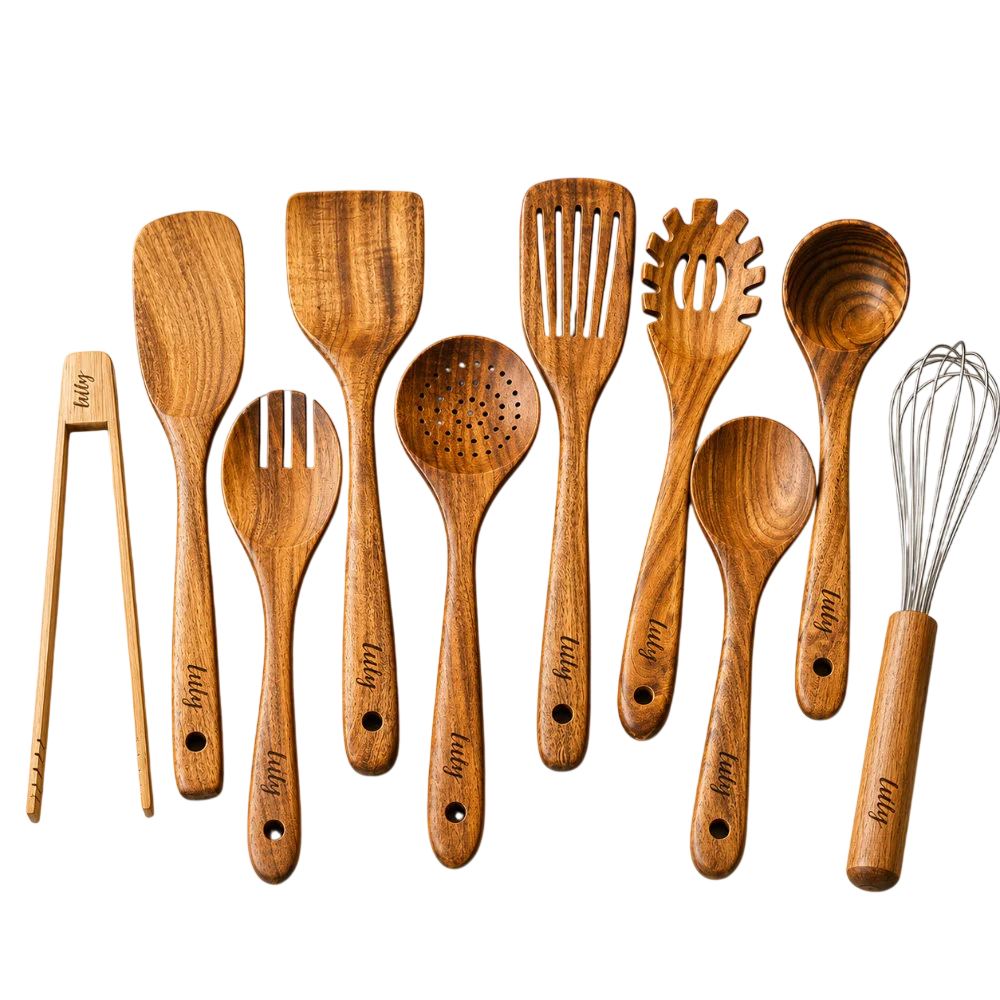
This 10-piece teak set covers every task at the stove. It flips, stirs, scrapes, and serves without touching your pan's seasoning.
★★★★★
Lilly Teak — 10 Piece Handmade Utensil Set
Handcrafted · Sustainable · Zero Plastic
The Lilly Teak 10-piece set is everything we look for in a kitchen essential: beautifully crafted from solid teak, shaped by hand for an ergonomic feel, and designed to serve your family for decades. Each piece is unique, with its own natural grain pattern — no two sets are ever identical.
- 10 essential kitchen tools
- Hand-shaped & finished
- Non-scratch on all cookware
- 100% solid teak wood
- Food-safe oil treatment
- Sustainably sourced wood
CARVED BY HAND, PASSED DOWN
The History of Wooden Kitchen Utensils
Wooden utensils go back thousands of years. Early cooks carved spoons and spatulas from local hardwoods, since wood stayed cool, resisted breaking, and required no forge or furnace to shape. These tools traveled from open-fire cooking to modern stovetops without much change in design.
Teak entered kitchens later, prized for a trait most woods lack: natural oil content. Shipbuilders first used teak for decks, since the wood resisted water and salt air for decades. Kitchen makers noticed the same durability and began carving spoons, spatulas, and tongs from the same wood. That oil content still sets teak apart from pine, maple, and other common utensil woods today.
Modern manufacturing brought silicone and nylon into kitchens during the twentieth century. Both materials solved narrow problems, like flexibility or low cost, but neither matched the strength or feel of solid wood. Teak utensils kept their place on countertops because they combine the softness cookware needs with the strength daily cooking demands.
What Makes Teak Utensils Worth Choosing
Natural Oil Content
Teak resists water without added sealant.
Heat Tolerance
Handles up to 200°C near hot pans.
Easy Cleanup
Smooth grain sheds food residue fast.
Non-Toxic Material
No coatings leach into hot food.
Balanced Grip
Solid wood feels stable in the hand.
Long Service Life
Oiled teak resists cracking for years.
"I switched my whole drawer to teak from Lilly Teak last year. The handles feel sturdy, the finish looks great after months of use, and cleanup takes seconds. I have not gone back to plastic since."
— Karen H.
BUILT FOR THE DRAWER, NOT JUST THE PAN
Technical Specifications of Teak Utensils
Material Density and Hardness
Teak carries a naturally dense grain, denser than pine or basswood. That density resists dents from daily stirring, scraping, and flipping. The wood also resists splitting along the grain, a common failure point in cheaper wood tools.
Heat Resistance
Teak utensils tolerate heat up to roughly 200°C, or 392°F. That range covers searing, frying, and sautéing on a standard stove. The wood will not melt or release fumes at these temperatures, unlike some plastics.
Edge and Surface Shape
A rounded or beveled edge matters more than sharpness for a kitchen utensil. Cast iron and non-stick cookware both need a tool that pushes food without digging into the surface. Wood shapes easily into rounded edges that match a pan's curve.
Finish Type
A plant-based finish seals the wood without synthetic chemicals. This finish keeps water out of the grain and keeps food contact fully safe, without the plastic taste some coated tools leave behind.
Weight and Balance
A utensil should feel steady in the hand, not light or hollow. Solid teak carries enough weight to feel stable during stirring, yet it stays light enough for long cooking sessions. Hollow plastic tools often feel unbalanced, and thin metal tools transfer heat straight to your hand.
Our Top Pick
The Set Built for Daily Kitchen Work
Stop reaching for mismatched tools at the stove. This set gives you a full range of shapes built from one durable material.
★★★★★
Lilly Teak — 10 Piece Handmade Utensil Set
Handcrafted · Sustainable · Zero Plastic
The Lilly Teak 10-piece set is everything we look for in a kitchen essential: beautifully crafted from solid teak, shaped by hand for an ergonomic feel, and designed to serve your family for decades. Each piece is unique, with its own natural grain pattern — no two sets are ever identical.
- 10 essential kitchen tools
- Hand-shaped & finished
- Non-scratch on all cookware
- 100% solid teak wood
- Food-safe oil treatment
- Sustainably sourced wood
MATERIAL BY MATERIAL
Teak vs Silicone vs Metal Utensils
|
Material |
Heat Resistance |
Surface Safety |
Best For |
|---|---|---|---|
|
Teak Wood |
Up to 200°C / 392°F |
Will not scratch seasoning |
Stirring, flipping, serving |
|
Silicone |
Up to 230°C / 446°F |
Safe, but can soften at edges |
Non-stick and low-heat tasks |
|
Metal |
Up to 400°C+ |
Scratches seasoning fast |
Cutting or breaking food apart |
Teak and silicone both protect a pan's surface. Teak wins on feel and durability, since silicone edges soften near a hot pan wall over time, and silicone tools often flex under heavier stirring. Metal stays the wrong daily choice, even though it survives the highest heat, since it scratches seasoning and non-stick coatings alike. Nylon tools resist scratching the same way silicone does, but nylon can melt against direct heat and loses its shape faster than solid wood.
CARE THAT KEEPS THE GRAIN TIGHT
Maintenance Steps for Teak Utensils
Teak utensils need simple, consistent care. Follow these steps to keep a set in good shape for years.
- Hand wash after each use. Avoid the dishwasher, since heat and detergent dry out the wood.
- Dry the utensil fully. Standing water swells the grain and causes cracks.
- Oil the wood monthly. A food-safe oil, like mineral oil, restores the finish and blocks moisture.
- Store away from direct heat. Keep utensils off the stovetop when not in use.
- Sand rough spots gently. Fine sandpaper smooths any raised grain after heavy use.
A well-maintained teak utensil can outlast several sets of cheaper wood or plastic tools. The wood does not rust, and its natural oil content means it needs less upkeep than pine or bamboo. A small amount of care each month keeps the finish tight and the grain smooth for years of daily use.
CHOOSING TOOLS THAT LAST
How to Choose the Best Utensils for Your Kitchen
Follow these steps to pick a set that fits your cooking style and your cookware.
- Check the material. Choose solid teak over composite or laminated wood pieces.
- Confirm the finish. Look for a plant-based or food-safe oil finish, not a plastic coating.
- Match the shape to your tasks. Pick a flat spatula for flipping, a slotted spoon for draining, and a solid spoon for stirring.
- Test the handle grip. A rounded handle reduces hand strain during long cooking sessions.
- Buy a full set, not single pieces. A matched set covers more tasks and looks better in a utensil crock.
- Check the piece count. A 10-piece set covers stirring, flipping, serving, and draining without gaps.
- Look at the finish quality. A smooth, even coat signals careful hand-finishing, not a rushed factory process.
Our Top Pick
Fill Your Drawer With Tools Built to Last
Good cookware deserves good tools. Start with a utensil set built from solid teak.
★★★★★
Lilly Teak — 10 Piece Handmade Utensil Set
Handcrafted · Sustainable · Zero Plastic
The Lilly Teak 10-piece set is everything we look for in a kitchen essential: beautifully crafted from solid teak, shaped by hand for an ergonomic feel, and designed to serve your family for decades. Each piece is unique, with its own natural grain pattern — no two sets are ever identical.
- 10 essential kitchen tools
- Hand-shaped & finished
- Non-scratch on all cookware
- 100% solid teak wood
- Food-safe oil treatment
- Sustainably sourced wood
FAQ
Yes. Teak resists scratching a seasoned surface, unlike metal tools that cut through seasoning over time.
Teak carries natural oils that resist water and cracking. Most other woods need more frequent oiling to match that durability.
Oil the wood once a month under normal use. Oil more often if you wash the utensils daily.
No. Dishwasher heat and detergent dry out the grain and cause cracks over time.
A flat-edged spoon works best for stirring and scraping the bottom of a pan.
Rarely, if you dry them fully after each wash. A monthly oil coat also blocks odor absorption.
Final Verdict
Teak utensils earn their place in any kitchen. They resist heat, protect cookware, and last for years with simple care. A solid teak set covers every stovetop task without the wear that plastic or metal tools cause.
Choose a set built from solid teak with a food-safe finish. Match the shapes to your cooking habits, and treat the set to regular oiling. A good set of utensils rewards that small effort with years of reliable use in every pan you own.
Good tools shape how you cook. Choose teak, and your kitchen will feel the difference every day. 🌿