FREE WORLDWIDE SHIPPING

Wooden vs. Silicone Cooking Utensils: Which Is Better for Your Kitchen?

"Every kitchen drawer holds a quiet argument: warm, hand-shaped wood against flexible, heat-tolerant silicone. Each material stirs, scrapes, and flips differently. This guide compares heat limits, cookware safety, care, and lifespan. Use it to fill your drawer with tools you trust for years."
Wooden and silicone cooking utensils sit in most kitchen drawers. Both stir sauces, flip eggs, and scrape pans. They differ in heat behavior, cookware safety, care, and lifespan. Those four factors decide which material earns your daily use.
Teak leads the wooden category. This dense hardwood resists moisture, protects nonstick surfaces, and ages gracefully. Silicone wins on flexibility and easy cleanup. Your cooking style decides the winner, and the facts below make that choice simple.
Gentle on Pans
SOFT GRAIN, ZERO SCRATCHES
Cool in Hand
NO HEAT TRANSFER
Built to Last
DECADES OF USE
The sections below cover history, specifications, benefits, care, and a five-step selection checklist. Each one gives you facts you can apply today.
🌿
Our Top Pick
Start With Solid Teak
Great utensils need a great work surface. This handmade teak board prepares your ingredients gently, then pairs with any wooden spoon on your stove.
✦ Editor's Pick ✦
★★★★★
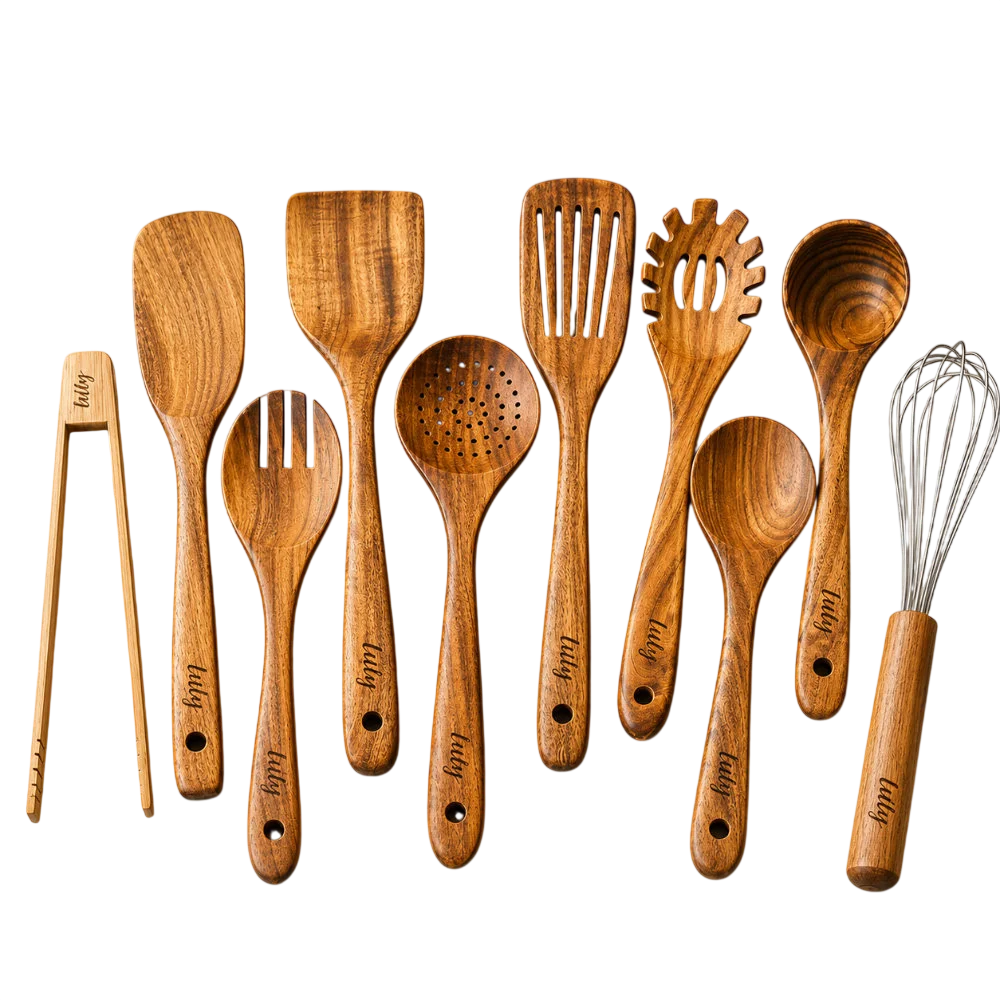
Lilly Teak — 10 Piece Handmade Utensil Set
Handcrafted · Sustainable · Zero Plastic
The Lilly Teak 10-piece set is everything we look for in a kitchen essential: beautifully crafted from solid teak, shaped by hand for an ergonomic feel, and designed to serve your family for decades. Each piece is unique, with its own natural grain pattern — no two sets are ever identical.
- 10 essential kitchen tools
- Hand-shaped & finished
- Non-scratch on all cookware
- 100% solid teak wood
- Food-safe oil treatment
- Sustainably sourced wood
🌿
FROM CARVED SPOON TO SILICONE
Utensil History
Cooks have carved wooden spoons for thousands of years. Early spoons appear in ancient Egyptian and European archaeological records. Wood was cheap, available, and kind to clay and iron pots.
Teak earned its reputation on ships. Builders in South and Southeast Asia prized it for decks because it resisted rot and saltwater. Kitchen makers later adopted the same wood for spoons, boards, and bowls.
Artisans still shape teak the traditional way. They cut, carve, sand, and finish each piece by hand. That process keeps the grain intact and gives every spoon its own character.
Silicone arrived much later. Chemist Frederic Kipping coined the term in the early 1900s. Dow Corning began commercial production in the 1940s. Silicone cookware then reached home kitchens over the following decades.
Cooks welcomed silicone for one reason: it tolerated heat that melted older plastic tools. Brightly colored spatulas, baking mats, and molds soon filled store shelves. Today, many households own both materials and use them side by side.
🌿
HEAT, HARDNESS, AND SAFETY
Technical Specifications
Teak Wood Utensils
- Hardness: Teak measures roughly 1,000 lbf on the Janka scale. It is firm enough to last and soft enough to protect pans.
- Natural oils: Teak contains natural oils that repel water and slow rot.
- Heat behavior: Wood conducts little heat, so handles stay cool. Wood does not melt, but extreme heat can scorch it.
- Surface: A fine, tight grain needs only a food-safe oil finish.
Silicone Utensils
- Heat tolerance: Quality food-grade silicone usually withstands 400°F to 600°F (204°C to 315°C). Check the label for the exact rating.
- Flexibility: Soft edges scrape bowls and pan corners cleanly.
- Surface: The non-porous surface resists bacteria. Oils and strong colors can still linger.
- Purity: Low-cost sets may contain fillers. Choose platinum-cured silicone for the cleanest material.
What the Numbers Mean
Heat rating matters most for silicone. A spatula rated at 400°F handles sautéing and simmering. Deep frying and candy making push temperatures higher, so check the label first.
Hardness matters most for wood. A hardwood that is too soft dents quickly. A hardwood that is too hard can scratch coatings. Teak sits in the middle, which makes it a dependable choice for everyday cookware.
Environmental Impact
Responsibly sourced teak is a renewable material. A single spoon can serve a household for decades, which cuts waste. Silicone lasts a long time too, but most municipal recycling programs do not accept it. Longevity and end-of-life disposal both deserve a place in your decision.
🌿
SIX REASONS TEAK EARNS ITS PLACE
Teak Benefits
Teak solves the most common utensil complaints. It stays cool, protects cookware, and looks better with age.
Each benefit below comes from the wood itself. No coatings, fillers, or synthetic blends are involved. A well-oiled teak spoon also develops a soft, warm sheen that plastic cannot match.
🍳
Cookware-safe
Soft grain glides over nonstick and cast iron.
🌡️
Cool handles
Teak stays comfortable over a hot pot.
🛡️
Water-resistant
Natural oils resist moisture, stains, and warping.
🤲
Hand-shaped
Each tool fits the palm with a balanced grip.
🌱
Sustainable
Solid wood adds no synthetic fillers to your food.
🪵
Unique grain
Every piece carries its own pattern and deepens with oiling.
"I replaced my old plastic spatulas with teak spoons. They feel great, and my nonstick pan still looks new."
— Caroline B.
🌿
Our Top Pick
Prep the Teak Way
Wooden spoons work best beside a wooden board. Chop your onions on teak, then stir them in the pan. The board's plant-based finish stays food-safe and protects your knife edges.
✦ Editor's Pick ✦
★★★★★
Lilly Teak — 10 Piece Handmade Utensil Set
Handcrafted · Sustainable · Zero Plastic
The Lilly Teak 10-piece set is everything we look for in a kitchen essential: beautifully crafted from solid teak, shaped by hand for an ergonomic feel, and designed to serve your family for decades. Each piece is unique, with its own natural grain pattern — no two sets are ever identical.
- 10 essential kitchen tools
- Hand-shaped & finished
- Non-scratch on all cookware
- 100% solid teak wood
- Food-safe oil treatment
- Sustainably sourced wood
🌿
FIVE MINUTES OF CARE
Care Guide
Care routines differ by material. Teak asks for a little attention. Silicone asks for almost none.
Teak Care Steps
- Wash by hand with warm water and mild soap.
- Rinse quickly. Never soak wooden utensils.
- Dry with a towel, then air dry upright.
- Rub in food-safe oil once a month, or when the wood looks dull.
- Sand away any rough spots with fine sandpaper.
Common Mistakes to Avoid
- Soaking overnight: Long soaks swell the grain and cause cracks.
- Leaving spoons in hot pots: Resting a spoon on a hot pan edge scorches the handle.
- Skipping oil: Dry wood absorbs stains and splits faster.
- Using harsh cleaners: Bleach and strong detergents strip the natural oils.
Silicone Care Steps
- Wash in the dishwasher or by hand with dish soap.
- Soak stained pieces in warm, soapy water.
- Replace any piece that cracks, turns sticky, or keeps an odor.
- Wash greasy pieces right after use, because oils cling to the surface.
🌿
FIVE QUESTIONS, ONE CLEAR ANSWER
How to Choose
Follow these five steps to pick the right utensils for your kitchen.
- Check your cookware. Nonstick, enameled, and cast iron surfaces all need soft tools. Teak and silicone both qualify.
- Match your heat level. Wood handles most stovetop cooking. Confirm the printed temperature rating before using silicone for high-heat searing.
- Pick your task. Choose silicone for baking and bowl scraping. Choose teak for stirring, sautéing, and serving.
- Weigh your care time. Choose silicone if you want dishwasher convenience. Choose teak if you accept a monthly oil rub.
- Think long term. Teak lasts for decades with care. It also replaces plastic with a renewable material.
Most kitchens benefit from both materials. Keep a few silicone scrapers for baking. Build your daily set from teak.
Best Uses by Task
- Stirring soups and sauces: Teak spoons keep your hand cool over the steam.
- Flipping eggs and fish: A thin teak turner slides under food without tearing it.
- Scraping bowls and jars: Silicone spatulas bend to reach every corner.
- Serving salads and pasta: Teak looks warm on the table and feels solid in the hand.
- Baking: Silicone brushes and spatulas tolerate oven heat and wash up easily.
Start small if your budget is tight. Buy one teak spoon, one turner, and one spatula. Those three tools cover most weeknight recipes. Add pieces as your cooking habits show you what is missing.
🌿
SIDE-BY-SIDE RESULTS
Teak vs. Silicone
|
Factor |
Teak Wood |
Silicone |
Winner |
|---|---|---|---|
|
Heat handling |
Cool handle, no melting |
Tolerates 400°F to 600°F |
Teak |
|
Cleanup |
Hand wash, monthly oil |
Dishwasher safe |
Silicone |
|
Lifespan |
Decades with care |
Years before cracks or odors |
Teak |
Teak wins two of three categories. Silicone wins on convenience. Your priorities decide which advantage matters more. Cooks who value convenience lean toward silicone. Cooks who value feel, longevity, and a plastic-free kitchen lean toward teak.
🌿
Our Top Pick
Finish the Kitchen Set
Pick your teak spoons, then complete the setup with one board. A single solid teak surface carries you from prep to plating.
✦ Editor's Pick ✦
★★★★★
Lilly Teak — 10 Piece Handmade Utensil Set
Handcrafted · Sustainable · Zero Plastic
The Lilly Teak 10-piece set is everything we look for in a kitchen essential: beautifully crafted from solid teak, shaped by hand for an ergonomic feel, and designed to serve your family for decades. Each piece is unique, with its own natural grain pattern — no two sets are ever identical.
- 10 essential kitchen tools
- Hand-shaped & finished
- Non-scratch on all cookware
- 100% solid teak wood
- Food-safe oil treatment
- Sustainably sourced wood
🌿
FAQ
Are wooden utensils sanitary?
Yes. Wash and dry them after each use. Teak's dense grain and natural oils limit moisture absorption. Replace any piece that develops deep cracks, because bacteria can hide there.
Is silicone safe for cooking?
Food-grade silicone stays stable within its rated temperature. Choose platinum-cured sets and avoid pieces with fillers. Never use silicone above its printed temperature rating.
Can I put wooden utensils in the dishwasher?
No. Heat and prolonged water exposure crack and dry out the wood. Hand washing takes under a minute and protects your investment.
How often should I oil teak utensils?
Oil them once a month, or whenever the surface looks dry or pale. Use a food-safe oil and wipe off the excess after ten minutes.
Which material scratches nonstick pans less?
Both are gentle. Teak and silicone are softer than any pan coating.
When should I replace my utensils?
Replace wooden pieces with deep cracks or splinters. Replace silicone pieces that crack, feel sticky, or hold odors.
🌿
Final Verdict
Silicone offers heat tolerance and effortless cleanup. Teak offers cool handles, natural water resistance, and decades of service. Both protect your cookware, so neither choice harms your pans. The real difference shows up over years of use. Teak gains character, while silicone eventually discolors or cracks. A teak set also looks good enough to leave on the counter.
For a daily set, choose teak. Add silicone scrapers for baking and high-heat tasks. Pair both with a solid teak board, and your kitchen runs on durable, plastic-free tools.
Teak for daily cooking, silicone for baking. 🌿