
Best Cutting Board for Meat

A cutting board carries every cut you make. The wrong one dulls your knife and hides bacteria in its scars. The right one protects your blade, resists stains, and turns raw meat prep into a clean, controlled task instead of a risky one."
Raw meat prep punishes a cutting board fast. Deep knife scars trap juices. Trapped juices breed bacteria. A poor surface also dulls your knife edge within weeks. Every slice, chop, and trim adds another groove to the surface, and those grooves compound over months of regular use until the board becomes a liability instead of a tool.
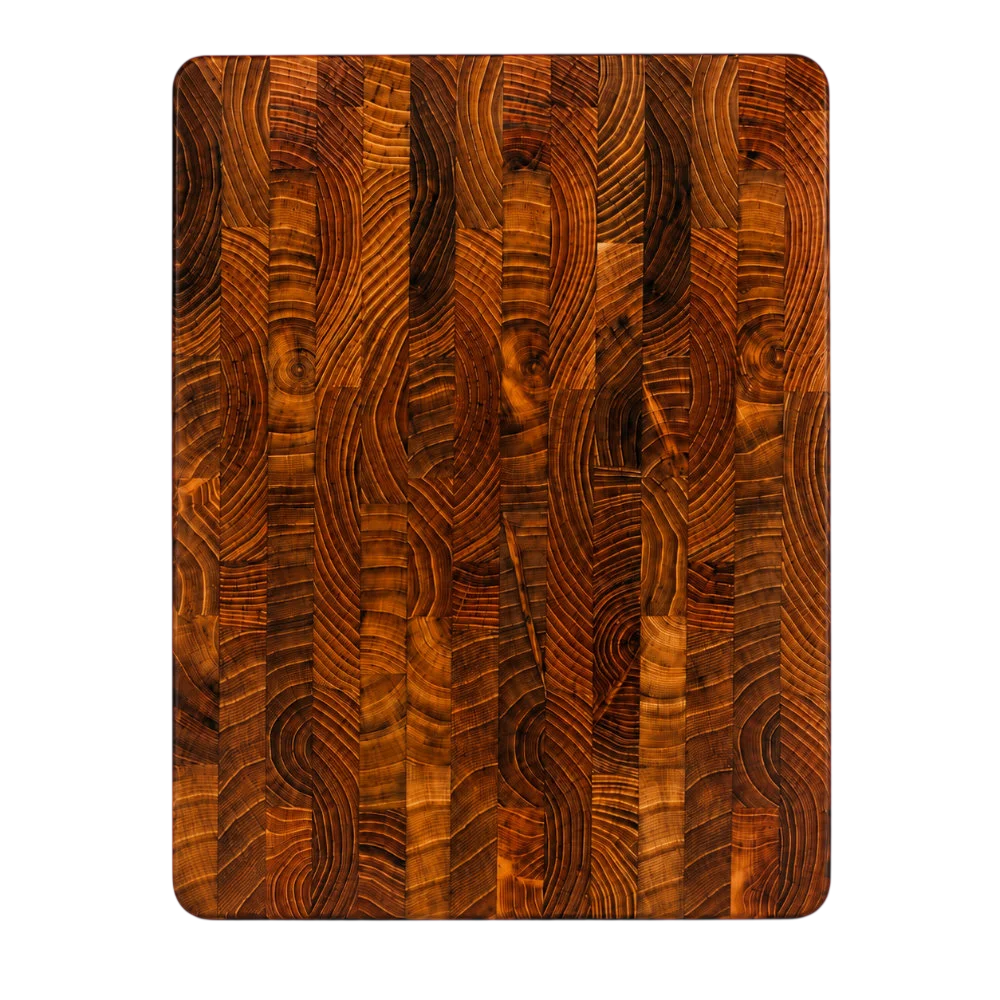
The right board solves both problems at once. End-grain teak absorbs knife impact and closes back up after each cut, so bacteria have fewer places to hide. This guide walks through the material, the specs, and the exact steps to pick a board built for meat. We'll cover what separates a board that lasts a decade from one that ends up in the trash after a single season, and why the difference usually comes down to how the wood was cut and finished rather than how much you spent.
Knife Protection
KNIFE-SAFE CUTTING SURFACE
Bacteria Defense
BLOCKS BACTERIA BUILD-UP
Built to Last
LASTS FOR DECADES
A meat cutting board is not a place to save money. A thin, hard, or porous board wears out fast and puts your food safety at risk. Solid teak solves this with natural oils that resist moisture and a tight grain that holds up under daily butchery. That combination of oil content and grain density is what commercial kitchens have relied on for generations, long before "food-safe finish" became a marketing term. A board that fights moisture on its own, without a synthetic sealant, simply holds up better under the kind of daily wear a home kitchen puts it through.
Our Top Pick
The Board We Recommend for Meat Prep
Most boards on the market use thin edge-grain wood or plain plastic. Neither one matches the density and natural oil content of solid teak. Here is the board we point people to first. It's the board we'd put in front of anyone who prepped meat daily and asked for a single recommendation, no follow-up questions needed.
★★★★★
Lilly Teak — Handmade Teak Cutting Board with Plant-Based Finish
Handcrafted · Sustainable · Zero Plastic
The Lilly Teak cutting board is everything we look for in a kitchen essential: carved from solid teak, hand-shaped for durability, and finished with a 100% plant-based oil that keeps your board food-safe without a trace of synthetic sealant. Each board carries its own natural grain pattern — no two are ever identical.
- Solid teak cutting surface
- Hand-shaped & finished
- Gentle on knife edges
- 100% solid teak wood
- Plant-based food-safe finish
- Sustainably sourced wood
MATERIAL SCIENCE
Why Material Choice Drives Food Safety
A cutting board's material decides how it handles bacteria, moisture, and knife wear. Wood, plastic, composite, and stone all behave differently under raw meat. The differences aren't cosmetic — they show up directly in how much bacteria survives a wash cycle and how fast your knives lose their edge.
Wood fibers close back up after a cut. This self-healing trait limits deep bacterial pockets. Hard surfaces like glass and stone do the opposite: they scar permanently and dull your blade with every pass. Once a hard surface scars, that groove is there for good — there's no oiling or conditioning routine that reverses it, unlike wood.
End-grain wood faces the fiber ends toward the blade. This orientation is the most knife-friendly cut of wood and the most durable under heavy use. Edge-grain wood faces the fiber length toward the blade. It costs less but wears down faster. Thickness plays a role too. A board under an inch thick flexes under pressure, which accelerates surface cracking and makes the wood more prone to warping when it dries out between uses. Anything at or above 1.5 inches keeps its shape through repeated wet-dry cycles and gives a knife more resistance to push against, which actually makes cutting safer and more controlled.
Teak also holds up better than other hardwoods people consider for this job. Maple and walnut are popular for cutting boards, but neither carries teak's natural oil content, which means they need more frequent conditioning to stay moisture-resistant. Bamboo, despite its "eco-friendly" reputation, is technically a grass rather than a hardwood — it's harder on knife edges than true end-grain wood and tends to split along its fibers faster under the repeated pressure of meat prep. Teak sits in a category of its own: dense enough to resist scarring, oily enough to resist water, and forgiving enough on a blade that it doesn't need to be babied.
Knife Protection
Preserves blade sharpness longer.
Bacteria Resistance
Natural oils slow bacterial growth.
Moisture Control
Resists warping and water damage.
Durability
Withstands years of daily cutting.
Easy Maintenance
Simple oiling keeps it food-safe.
Sustainable Material
Renewable, plant-based, plastic-free.
"I replaced three plastic boards in two years before I switched to teak. This one still looks new after eight months of daily use."
— Priya N.
Our Top Pick
The Board That Balances Durability and Safety
Halfway through your search, the choice usually comes down to one question: which board will still perform well a year from now? Teak keeps answering that question the same way. It's not the flashiest material on the shelf, but it's the one that still looks and performs the same after the twelve-month mark, which is exactly when cheaper boards start showing their age.
★★★★★
Lilly Teak — Handmade Teak Cutting Board with Plant-Based Finish
Handcrafted · Sustainable · Zero Plastic
The Lilly Teak cutting board is everything we look for in a kitchen essential: carved from solid teak, hand-shaped for durability, and finished with a 100% plant-based oil that keeps your board food-safe without a trace of synthetic sealant. Each board carries its own natural grain pattern — no two are ever identical.
- Solid teak cutting surface
- Hand-shaped & finished
- Gentle on knife edges
- 100% solid teak wood
- Plant-based food-safe finish
- Sustainably sourced wood
SIDE-BY-SIDE
How the Main Materials Compare
The table below lines up the four common choices side by side. We've limited it to the materials people actually consider for meat prep, since novelty options like bamboo composite or rubber wood tend to fall somewhere between wood and plastic without excelling at either.
|
Material |
Knife Friendliness |
Bacteria Resistance |
Best Use |
|---|---|---|---|
|
End-Grain Teak |
Excellent |
High, natural antimicrobial oils |
Daily meat prep, heavy chopping |
|
HDPE Plastic |
Good |
Moderate, grooves trap bacteria over time |
Commercial kitchens, raw poultry |
|
Composite |
Good |
High, nonporous surface |
Heavy daily use |
|
Glass/Stone |
Poor |
High surface, but knife slides |
Not recommended for meat |
Teak wins on the two factors that matter most for meat: how it treats your knife and how it resists bacteria between washes. Plastic still holds its place in commercial settings where a full dishwasher cycle runs after every shift. Composite boards close that gap somewhat, but they still can't self-heal after a cut the way solid wood does, and glass or stone boards are worth avoiding entirely for meat work — the hard surface transfers every bit of impact straight back into your blade edge, which means more frequent sharpening no matter how careful you are.
Our Top Pick
Ready to Upgrade Your Meat Prep Station?
You now know what separates a good meat cutting board from a poor one. If you want the version that checks every box, this is the one we keep coming back to. It's the board we'd tell a friend to buy once instead of replacing three times.
★★★★★
Lilly Teak — Handmade Teak Cutting Board with Plant-Based Finish
Handcrafted · Sustainable · Zero Plastic
The Lilly Teak cutting board is everything we look for in a kitchen essential: carved from solid teak, hand-shaped for durability, and finished with a 100% plant-based oil that keeps your board food-safe without a trace of synthetic sealant. Each board carries its own natural grain pattern — no two are ever identical.
- Solid teak cutting surface
- Hand-shaped & finished
- Gentle on knife edges
- 100% solid teak wood
- Plant-based food-safe finish
- Sustainably sourced wood
FAQ
Choose at least 1.5 inches. Thicker boards resist warping and absorb heavy knife impact. Anything thinner tends to bow after a few months of regular washing and drying.
Yes. Teak's natural oils resist moisture absorption, which slows bacterial growth between washes. Combined with regular hand washing, that natural resistance keeps the surface safer than most people expect from an untreated wood.
Oil it once a month with food-grade mineral oil to prevent drying and cracking. Boards used daily for meat prep may need oiling every two to three weeks, especially in drier climates.
No. Hand wash it and dry it upright. Soaking or dishwashing causes warping and cracking. The heat and prolonged water exposure strip the natural oils out of the wood far faster than normal use ever would.
No. Keep a dedicated board for raw meat to avoid cross-contamination. A second board for produce and bread keeps raw juices away from anything you plan to eat without cooking first.
An 18 by 24 inch board fits most home kitchens and most standard cuts of meat. Larger cuts, like a whole brisket or a full chicken, benefit from a board closer to 20 by 28 inches so nothing hangs off the edge while you work.
Most handmade teak boards, including plant-based-finished ones, arrive pre-conditioned and ready to use straight out of the box. It's still worth doing a light oiling before the first cut just to confirm even coverage, especially around the edges and any exposed end grain, which tends to absorb oil faster than the flat cutting surface.
Final Verdict
A meat cutting board needs three things: a knife-friendly surface, natural resistance to bacteria, and a maintenance routine you will actually keep up with. Solid teak checks all three boxes better than plastic, composite, or stone.
Most people replace a cutting board two or three times before they find one that actually holds up. Skipping that cycle by starting with a dense, well-finished board saves money over time and keeps the kitchen safer in the meantime — the two goals end up pointing in the same direction.
Pick a board sized for your largest cuts. Confirm it measures at least 1.5 inches thick. Then commit to a monthly oiling routine, and it will outlast every plastic board you have owned.
None of this requires a complicated shopping process. Look for solid end-grain construction, a thickness of at least 1.5 inches, and a finish that's plant-based rather than synthetic — those three checkpoints filter out almost every board that would otherwise end up warped, scarred, or replaced within a year. The rest comes down to keeping up a simple monthly habit: wash by hand, dry upright, and oil it before the surface starts to look dry.
A sharp knife, a clean cut, a board that closes back up behind it — that's what teak brings to the counter every time. 🌿